


Mikko Möttönen selected as finalist for the European Inventor Award 2026
Möttönen is a finalist in the ‘Research’ category for developing an ultrasensitive cryogenic microwave sensor to diagnose interference in quantum computers.

The fundamentals of quantum mechanics are miniscule. Scientists constantly home in on finer resolutions to measure, quantify, and control these fundamentals like photons that carry light. The more precise the measurement, the more possibilities for better quantum technology or the ability to detect elusive dark-matter axions in deep space.
Now, researchers in Finland have successfully used a calorimeter, a type of ultra-sensitive heat-based energy sensor, to detect energy levels below one zeptojoule, or a trillionth of a billionth of a joule. For context, a zeptojoule is approximately the amount of work it takes for a red blood cell to move a nanometre, or a billionth of a metre, upwards in Earth’s gravity.
The team, led by Academy Professor Mikko Möttönen at Aalto University, together with an industry collaborator IQM and the Technical Research Centre of Finland (VTT), used a novel technique to achieve the milestone measurement. The study was published on May 12 in the journal Nature Electronics:
At such a miniscule scale, measuring is far more complex than just firing a beam and seeing the results pop up. The team shot a microwave pulse into a sensor that they had built from two different kinds of metals: superconductors, where the pulse traveled freely, and regular conductors, which put up resistance.
‘That combination of metals makes superconductivity such a fragile phenomenon that it weakens immediately if the temperature in the ultracold conductor rises even a little bit. This makes it such a sensitive setup,’ says Möttönen, who is also a founder of the quantum computer unicorn IQM.
After optimized filtering, the team read out the final result. It showed their setup had detected an electromagnetic pulse so minute it beggars belief: only 0.83 zeptojoules, or less than a trillionth of a billionth of a joule. The result is a world-first for calorimetric measurement devices which are considered some of the most sensitive in the field.
Academy Professor Mikko MöttönenIn the future, our device could be a component for reading out qubits in quantum computers.
The study paves the way to counting individual photons. According to Möttönen, such sensitivity is a long-sought goal not just in quantum technology but fields like astrophysics.
"We want to make this setup capable of measuring input that has an arbitrary time of arrival, which is important for things like detecting dark-matter axions in space when you have no idea when they might reach your system.’
Möttönen envisions that their calorimeter could be integrated into a variety of measurement setups due to a key advantage.
‘A calorimeter operates in the same millikelvin temperatures that qubits require. This introduces less disturbance into the system as we don’t have to bring the device to a high temperature or amplify the qubit measurement signal to get a result. In the future, our device could be a component for reading out qubits in quantum computers, for example.’
The team used the facilities of , Finland’s national research infrastructure for nano-, micro- and quantum technologies. This result mainly stems from the Future Makers project funded by the Jane and Aatos Erkko Foundation and the Technology Industries of Finland Centennial Foundation.
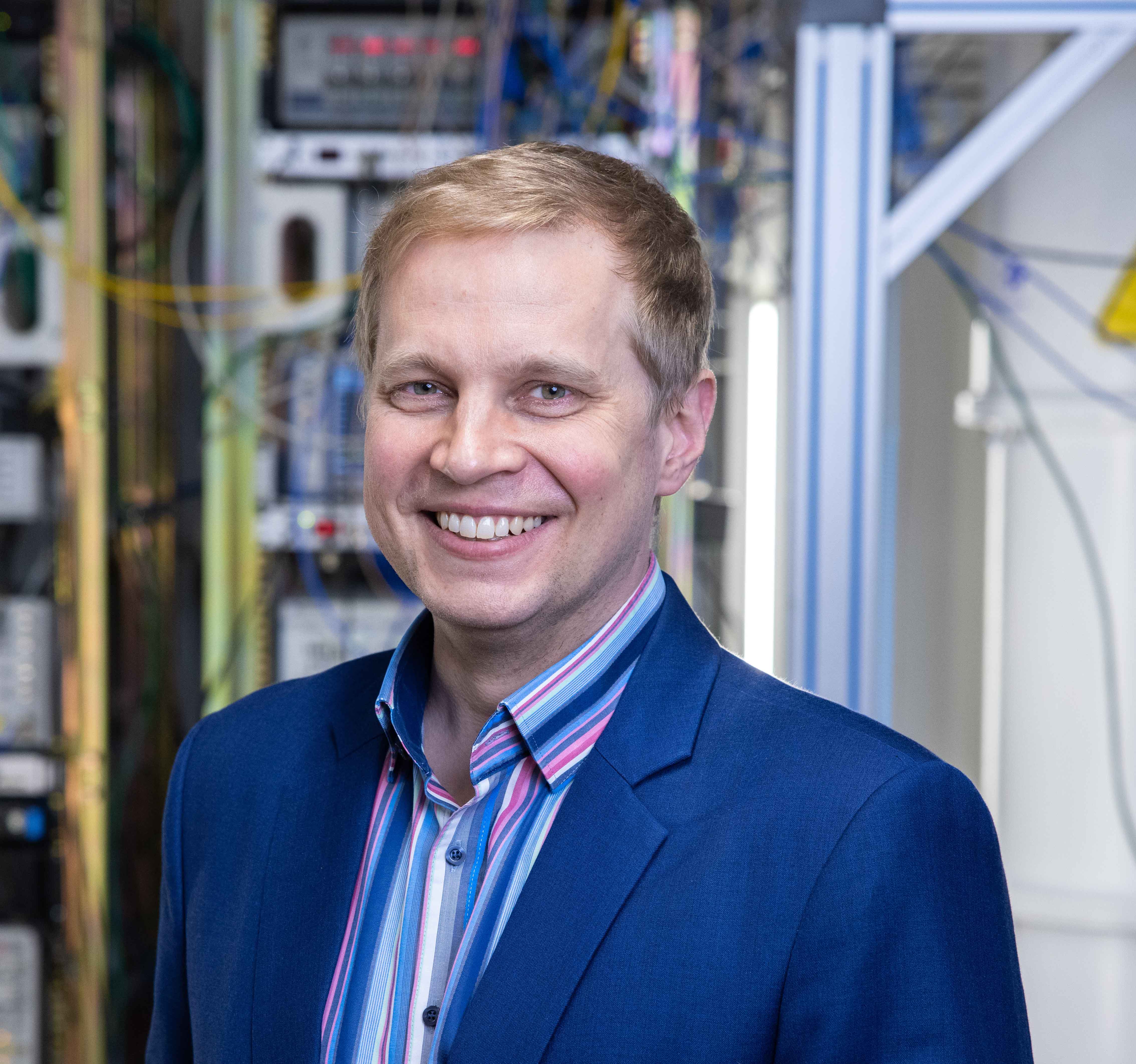

Möttönen is a finalist in the ‘Research’ category for developing an ultrasensitive cryogenic microwave sensor to diagnose interference in quantum computers.

OtaNano is Finland's national research infrastructure for micro-, nano-, and quantum technologies
We have a major effort on experimental low-temperature physics, but we also carry out computational and theoretical work down to fundamental quantum mechanics.


