


Quantum Computing and Devices (QCD)
We have a major effort on experimental low-temperature physics, but we also carry out computational and theoretical work down to fundamental quantum mechanics.

On July 8, 2025, physicists from Aalto University in Finland published a transmon qubit coherence measurement dramatically surpassing previous scientifically published records. The millisecond coherence measurement marks a quantum leap in computational technology, with the previous maximum echo coherence measurements approaching 0.6 milliseconds.
Longer qubit coherence allows for an extended window of time in which quantum computers can execute error-free operations, enabling more complex quantum computations and more quantum logic operations before errors occur. Not only does this allow for more calculations with noisy quantum computers, but it also decreases the resources needed for quantum error correction, which is a path to noiseless quantum computing.
‘We have just measured an echo coherence time for a transmon qubit that landed at a millisecond at maximum with a median of half a millisecond,’ says Mikko Tuokkola, the PhD student who conducted and analysed the measurements. The median reading is particularly significant, as it also surpasses current recorded readings.
The findings have been just published in the prestigious peer-reviewed journal Nature Communications:
The researchers report their approach as thoroughly as possible, with the aim of making it reproducible for research groups around the world.
Tuokkola was supervised at Aalto University by postdoctoral researcher Dr. Yoshiki Sunada, who fabricated the chip and built the measurement setup.
‘We have been able to reproducibly fabricate high-quality transmon qubits. The fact that this can be achieved in a cleanroom which is accessible for academic research is a testament to Finland's leading position in quantum science and technology,’ adds Sunada who is currently working at Stanford University, USA.
The work is a result of the Quantum Computing and Devices (QCD) research group which is a part of Aalto University’s Department of Applied Physics, (QTF), and (FQF).
The qubit was fabricated by the QCD group at Aalto using high-quality superconducting film supplied by the Technical Research Centre of Finland (VTT). The success reflects the high quality of Micronova cleanrooms at .
‘This landmark achievement has strengthened Finland's standing as a global leader in the field, moving the needle forward on what can be made possible with the quantum computers of the future,’ says Professor of Quantum Technology Mikko Möttönen, who heads the QCD group.
Scaling up the quantum computers of the future requires advancements across several domains. Among them are noise reduction, qubit-count increases, and the qubit coherence time improvements at the centre of the new observations from the QCD. The group just opened a and for achieving future breakthroughs faster.

Very recent data from the Quantum Computing and Devices (QCD) research group at Aalto University showing measurement results of the energy decay times T1 [blue color in (b) and (e)] and echo coherence times T2,echo [blue color in (a), (c), (d), and (f)] of a planar transmon qubit operating at 2.9-GHz frequency. The median energy decay times and echo coherence times (top left and center panels) are roughly half a millisecond and the highest recorded T2,echo = 1.06 ms (bottom left panel).
Image credit: Mikko Tuokkola / Aalto University.
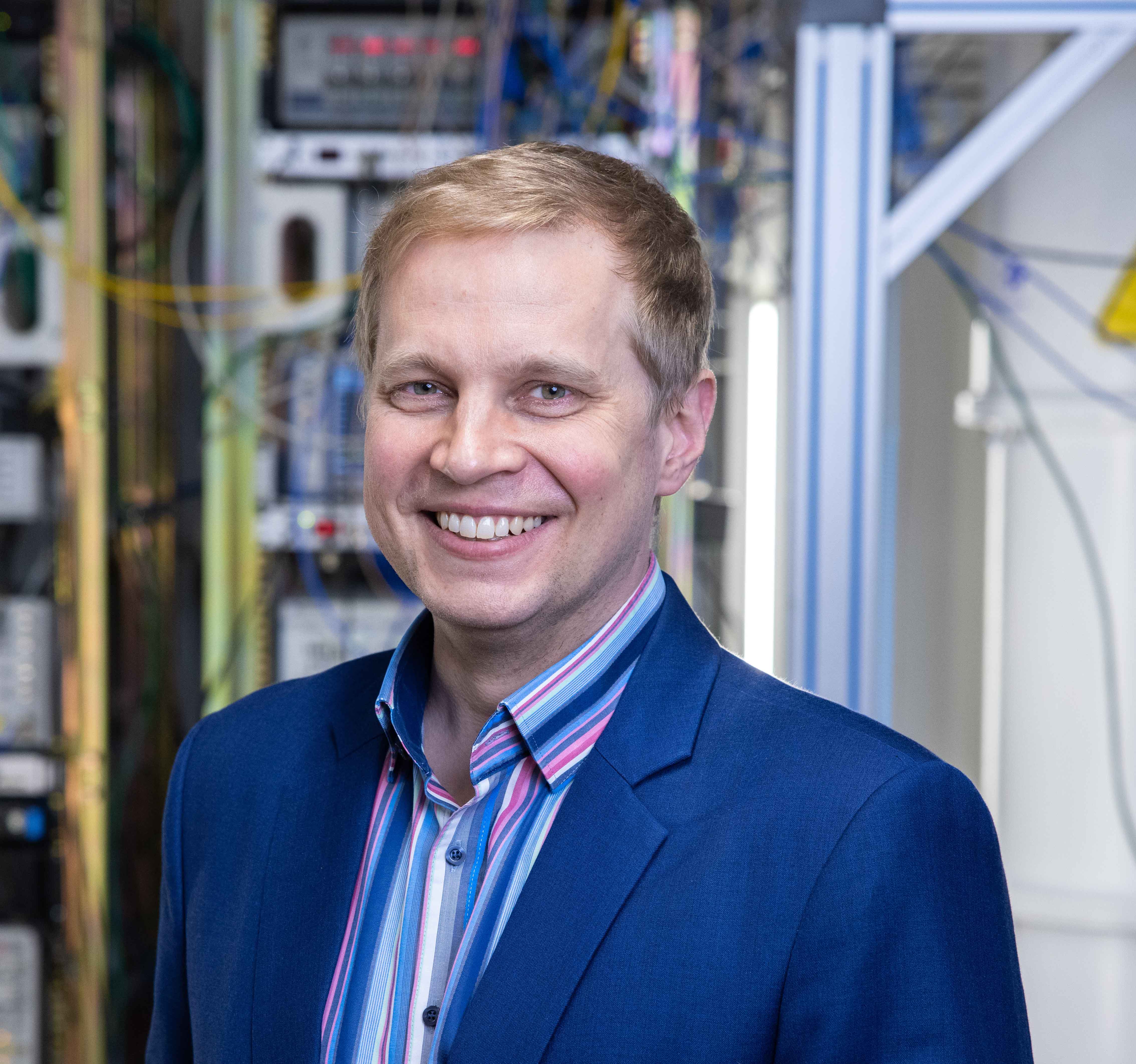
We have a major effort on experimental low-temperature physics, but we also carry out computational and theoretical work down to fundamental quantum mechanics.

OtaNano is Finland's national research infrastructure for micro-, nano-, and quantum technologies

Aalto University is coordinating the Finnish Quantum Flagship — an eight year project uniting quantum science and technology research institutions and and companies throughout Finland.

The national Quantum Technology Finland (QTF) Centre of Excellence brings together scientific and technological excellence and cutting-edge research infrastructures to harness quantum phenomena in solid-state-based quantum devices and applications.


