


Researchers aim to realize room-temperature superconductors starting with €2.7M in new funding

Improving the energy efficiency of the ICT sector is one of the motivations of global consortium , which Päivi Törmä, professor at Aalto University’s Department of Applied Physics, brought to life last year. This consortium has now secured substantial funding by two Finnish foundations: the has granted 2 million euros; and the , recently founded by Mika and Anu Anttonen, an additional 695 000 euros.
The SuperC consortium wants to realize a superconductor capable of operating at room temperature within a decade. This feat is one of the holy grails in physics, but it comes with its own set of challenges. Superconductors today are used in medical imaging and large magnets. Most current superconducting devices operate at roughly -269 degrees Celsius, which takes a lot of resources to achieve. In turn, room-temperature superconductivity would have significant implications for energy efficiency and carbon emission reduction.
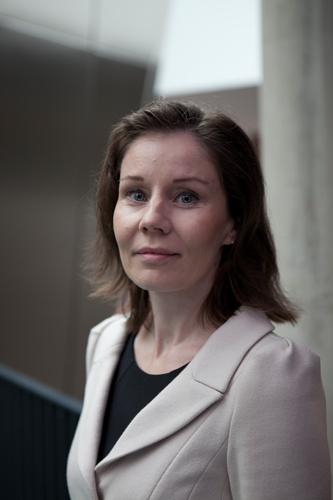
“I realized this sort of effort requires a global approach—one where I thought hard about choosing the right people to accomplish our goal,� Törmä said. “It was clear to me that the funding for this effort will have to come from private sources, as there are no suitable public funding instruments in place.�
Törmä, who also leads the Quantum Dynamics group, launched SuperC as a collaborative effort between 10 other global leaders in the fields of superconductivity physics, machine learning and materials science. With crosshairs aimed at improving a technology with wide-ranging applications, the new funding will aid SuperC in its endeavours as demand for energy-intensive ICT hardware grows.
Päivi TörmäI realized this sort of effort requires a global approach—one where I thought hard about choosing the right people to accomplish our goal.
A timely problem that needs solving
ICT consumes vast amounts of energy worldwide. The sector is estimated to contribute between 2 and 4 percent of all carbon emissions globally, and it is projected to continue its upward tick over the coming decades.
Driven by consumers, data centres and digitization efforts, current ICT technology relies on semiconductors. Those conductors consume energy to transmit electrical energy, and that energy is partially lost as heat in the process. Alternatively, superconducting materials provide a way to transfer electrical energy with 100 percent efficiency without any heat loss. It has been estimated that superconducting technology capable of operating at room temperature could provide 1 000 times more energy efficiency and 100 times higher clock frequency. Another application of new superconductors can be better magnets for fusion energy reactors.
Several recent scientific discoveries are likely to help the SuperC team to realize their vision of room-temperature superconductivity. Among those are the concept of flat-band superconductivity, where Törmä and her SuperC partners have made pioneering contributions, as well as new materials discovery powered by machine learning.
Thinking big
Törmä first conceived the idea for SuperC as a means to contribute her expertise in solving the global climate crisis. Studying the theory behind flat-band superconductivity has been at the heart of Törmä and her group’s work for over eight years. A recent example is a theoretical paper by Törmä’s group, which was also
The funding will help Törmä and her colleagues achieve their goal by providing a good start in securing the financial basis to carry out the necessary research over the coming years.
Törmä’s primary research interests are in many-body quantum physics, superconductivity, and nanophotonics.
Read more news

ACME at Unite! Research School 2026
Ahmed Othman and Shreeram Pillai participated in Unite! Research School 2026 in Torino and Oropa, Italy, joining an international doctoral programme focused on interdisciplinary collaboration, research communication, and academic development.
Strong results from the Research Council’s winter call
A total of 54 Aalto researchers received Academy Research Fellow or Academy Project funding from the Research Council of Finland. The total funding awarded ºÚÁÏÍø University amounts to 33.2 million euros.
The Foundation for the Advancement of Finnish Securities Markets awards Juho Tuuliainen and Ville Virkkunen for their excellent Master’s thesis in the field of finance
Both students will receive a €3,500 scholarship.